








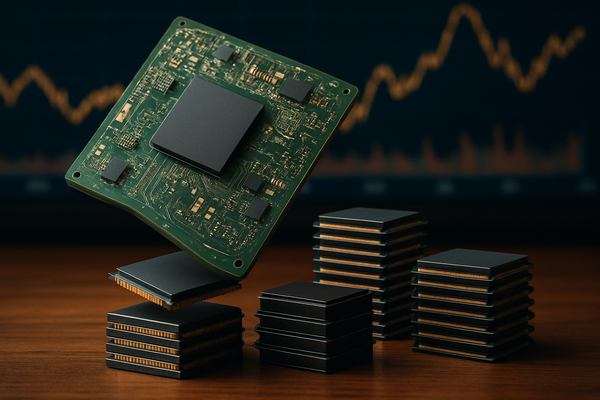
Nvidia weakness is redirecting cash into cheaper AI and semiconductor names and their supply chains. The pullback matters now because trade measures, China export delays for H200 chips, and a broader market retreat have reopened valuation conversations. In the short term, flows are accelerating into Advanced Micro Devices (NASDAQ:AMD), Intel (NASDAQ:INTC), Broadcom (NASDAQ:AVGO), Micron (NASDAQ:MU) and memory suppliers as investors trade price for exposure. Over the long term, fundamentals still favor AI leaders, but cheaper peers offer practical ways to capture infrastructure spending across the US, Europe, Asia and emerging markets relative to 2024–25 exuberance.
Why Nvidia’s re-rating is a catalyst this week
Nvidia (NASDAQ:NVDA) has led the AI hardware narrative for years. Recent headlines show a more complicated near term picture. Shares plunged on days when geopolitics and tariff talk spooked markets, and in a recent session NVDA closed at $178.18, down about 4.3% from the prior day. Regulators and trade frictions are now front and center. The U.S. cleared the H200 for export to China with conditions, yet Taiwanese server maker Inventec said H200 approvals “appear to be stuck” on the China side, and Chinese customs activity reportedly halted shipments. CEO Jensen Huang planning a China visit underscores how material access to that market remains.
At the same time, ratings and research remain supportive of Nvidia’s long-term role: Moody’s upgraded NVDA’s senior unsecured rating to Aa1, and brokers reiterated large AI backlogs. Those mixed signals — powerful demand versus shorter-term market, regulatory and valuation pressure — are what make the pullback a live trigger for rotation.
Where the money is going: cheaper AI exposure and supply chains
Investors are not abandoning AI; they are reallocating. Advanced Micro Devices (NASDAQ:AMD) is an early beneficiary. AMD’s hardware and software partnerships, plus enterprise deals such as its collaboration with Tata Consultancy Services, have raised expectations that the company can capture enterprise AI spend previously assumed to be Nvidia-dominant. Headlines note AMD outperformed Nvidia last year, and momentum is building into its AI comeback narrative.
Intel (NASDAQ:INTC) is surfacing as a value play on the server CPU and foundry story. Analyst upgrades and commentary ahead of Intel’s Q4 results pushed shares to a two-year high near $50. HSBC and Seaport upgrades cited improving server demand and foundry prospects, which attract investors looking for lower entry multiples to AI infrastructure exposure.
Broadcom (NASDAQ:AVGO) and Micron (NASDAQ:MU) are also central to the rotation. Broadcom has run hard over five years, prompting questions on margins and valuation, but its software and networking footprint tie directly into AI systems. Micron has been flagged by some strategists as an overlooked AI beneficiary as memory demand tightens. Meanwhile memory and storage suppliers such as Western Digital (NASDAQ:WDC) and Seagate (NASDAQ:STX) show pricing momentum; Bank of America has highlighted strong demand and pricing for these names in recent notes.
Policy, tariffs and the China factor are reshaping flows
Three policy threads are compressing valuations and re-routing capital right now: export controls, tariffs, and the Chinese market’s import stance. The U.S. has tightened guardrails on high-end AI chips and imposed tariff proposals that included items like the H200; at the same time, temporary Chinese customs measures have disrupted shipments. Those developments make exposure to a single AI hardware leader riskier in the near term, and they accelerate premium-to-value comparisons across the sector.
Globally, data center expansion continues. TSMC’s (mentioned in recent chips coverage) profit jumps and large capex pronouncements show capacity growth is being funded. But regional politics — U.S.-China dynamics and new tariff noise tied to Greenland — create windows where cheaper, domestically strong suppliers attract capital from Europe and the U.S., while Asian markets watch supply access closely.
Market consequences and pragmatic scenarios
This valuation-driven rotation has measurable market mechanics. When NVDA sells off on trade or regulatory headlines, cash flows into names with similar revenue exposure but lower multiples. That increases bid depth for AMD, INTC, AVGO and MU, and for second-tier suppliers like WDC and STX. The move is not a repudiation of Nvidia’s dominance. Rather, it is a reminder that investors manage positioning by price, access and policy risk.
For traders and portfolio managers, the immediate consequence is liquidity rebalancing across AI hardware stacks. For corporate watchers, the rotation pressures companies to clarify supply chain resilience, China access, and differentiated moats beyond raw GPU performance. Over time, the market may recombine leadership and valuation — as it did after earlier AI rallies — but in the short run the story is one of price-sensitive reallocation across servers, GPUs, CPUs, memory and systems integration.
What to watch next
- Regulatory headlines on H200 exports and Chinese customs rulings — they directly determine revenue windows for NVDA and partners.
- Earnings and guidance from Intel, AMD, Micron and Broadcom — analyst upgrades suggest room for multiple re-ratings if execution confirms demand.
- Memory pricing and supplier commentary — Seagate and Western Digital pricing signals will show whether downstream demand is broadening beyond GPUs into storage and DRAM.
In short, the current rotation is valuation-led, policy-fueled and global in reach. It is reshaping short-term flows while leaving the strategic, long-term AI infrastructure narrative intact. Investors and industry participants will watch both the policy headlines and earnings cadence to see whether this is a durable reallocation or a time-limited repricing opportunity.