










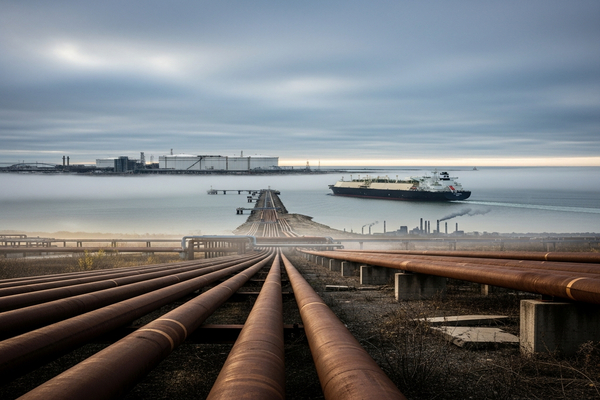
U.S. LNG margins under pressure as domestic prices surge. Domestic demand from new export plants and a cold northeast snap pushed Henry Hub above $5 per million British thermal units, the highest level in three years. Meanwhile Europe and Asia sit on ample LNG supplies and multi-year low prices, compressing the Henry Hub-TTF spread to its weakest since April 2021. The timing matters because 2025 set a record for project green lights, and a wave of new export capacity is due online by 2030. Short-term tightness is testing export earnings. Long-term capacity growth points to a structurally different flow of U.S. gas into global markets and heavier domestic competition for feedstock.
Why U.S. domestic prices are rising
Demand from LNG plants and colder weather tighten the Henry Hub market
U.S. gas prices climbed this week past $5 per mmBtu. New export plants are drawing more feed gas. Colder weather in the northeast added near-term heating demand. The combination pushed benchmark prices to levels not seen since 2022.
That matters now because U.S. producers face rising domestic offtake just as a large tranche of export capacity is being commissioned. When domestic consumption from LNG rises, pipeline flows are rerouted and local basis differentials widen. Those movements feed directly into the profitability of cargoes that depend on the Henry Hub-TTF spread.
Global glut keeps export prices low
Ample supplies in Europe and Asia cap spot prices and compress spreads
At the same time that U.S. prices have strengthened, European and Asian spot markets have remained subdued. Traders report multi-year low demand-center prices. That dichotomy has narrowed the spread between U.S. and European gas to its lowest point since April 2021. Narrow spreads cut the margin between selling a cargo abroad and the cost of producing it at home.
Market participants use the Henry Hub – TTF spread as a shorthand for export profitability. Many U.S. long-term contracts still benefited from wide spreads since late 2021. Those exceptional margins have now softened back toward normal levels. If the spread drops toward $4 per mmBtu, several contracts would be strained. If margins compress further toward $2 per mmBtu, which some analysts view as a proxy for production cost, operators may be forced to scale back output until margins recover.
Capacity surge and its market consequences
Record final investment decisions set up a bigger U.S. share of global LNG growth
The more structural factor is the sheer scale of planned additions. Between 2025 and 2030, new global LNG export capacity is forecast to rise by about 300 billion cubic meters per year, roughly a 50 percent increase on 2025 levels. The United States accounts for around 45 percent of that growth. In 2025 alone, 83 bcm per year of U.S. projects received final investment approval, a record pace for green lights.
U.S. gas production is expected to increase from around 39 trillion cubic feet in 2025 to about 42 trillion cubic feet by 2030, according to official projections. However, the share of gas consumed by LNG plants is forecast to climb from roughly 13 percent to near 20 percent. That combination creates a faster growing demand class inside the domestic market. The result is a higher floor under Henry Hub in stressed periods and a more competitive market for feedstock when plants vie for supply.
For traders and buyers, that means pricing dynamics will change. More cargoes will be linked to U.S. supply curves. More domestic production will be dedicated to export flows. The balance between domestic needs and export commitments will be an active price driver in the near term.
Policy moves and regional supply signals
EU phase-out of Russian gas and OPEC quota changes reshuffle flows and investment
Policy choices are reshaping demand routes. The European Union agreed to phase out Russian gas imports by late 2027. Russian LNG will be phased out by the end of 2026 and pipeline shipments by September 2027. That decision forces a reallocation of supply sources and will raise demand for alternative suppliers over the medium term. Some EU members face deeper adjustments than others, which will create uneven pressure on price and import patterns across the bloc.
At the same time, changes to OPEC+ production quota rules are likely to spur upstream investment among low-cost producers in the Gulf. Those moves could ease concerns about long-term oil shortages and influence investment returns across the hydrocarbon complex. Security risks also remain a factor. Attacks that disrupted oil infrastructure in parts of Iraq prompted diplomatic pressure and a swift reopening of a major export pipeline to Turkey. Such episodes underline how geopolitics can quickly alter flows and market psychology.
Corporate activity shows how companies are positioning for the new flows. Hungary’s MOL (BSE:MOL) has shown interest in assets owned by Lukoil (MCX:LKOH) according to recent headlines. That type of asset reshuffle could further redraw ownership of production and export capacity in key regions.
What this means for market participants
Short-term pressure on margins and longer-term rewiring of trade patterns
In the short term, U.S. LNG operators face squeezed margins as domestic feedstock costs climb while global selling prices remain weak. Plants coming online this year fixed much of their commerciality on broader spreads. As those spreads tighten, some cargoes that were viable during the 2021-2023 window will become less profitable.
Over the medium to long term, the ramp-up in capacity and the EU’s move away from Russian gas will reshape trade flows. The United States will play a larger role in supplying Europe and Asia, but that greater role will also draw more feed gas into exports and push domestic prices higher in stressed periods. Producers, buyers, and policymakers will need to factor in the growing competition for U.S. gas and the potential for swings in margins as capacity comes online.
This evolution matters now because project decisions made and contracts signed this year will determine how quickly new supply comes to market. That timing will influence spreads, investment returns, and regional energy security over the rest of the decade.