










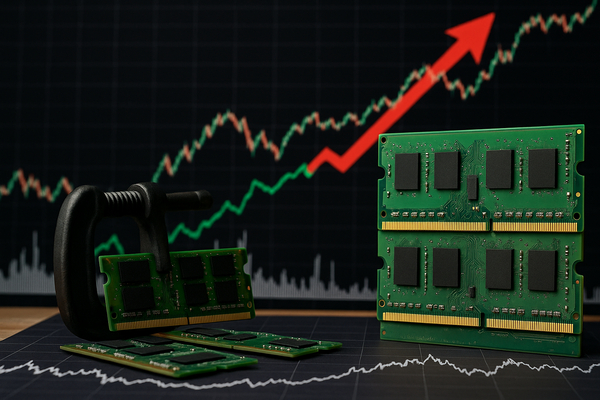
Apple revamps Siri with Google’s Gemini. Apple Inc. (NASDAQ:AAPL) this month sealed a multi‑year deal to base its next generation of foundation models on Google’s Gemini, reshaping the iPhone assistant into a Gemini‑powered chatbot while AI data‑center demand is driving a global memory shortage. Short term this fuels product buzz and stock moves; long term it redirects component supply toward servers and slows consumer device growth. The trend matters from the U.S. to China and Europe — it lifts data‑center suppliers like NVIDIA (NASDAQ:NVDA) while weighing on PC and phone makers that face higher memory bills.
Market Pulse Check
Investors moved quickly after two headlines converged: Apple’s (NASDAQ:AAPL) Gemini tie‑up and reports of surging memory prices. Trading volumes in large cap AI and chip stocks climbed, with NVIDIA (NASDAQ:NVDA) and Micron Technology (NASDAQ:MU) showing pronounced flows. ETFs tracking AI and semiconductors saw increased inflows, while some consumer‑tech names saw short‑term outflows.
Sentiment split along exposure lines. Funds with data‑center and GPU exposure rallied. Portfolio managers trimmed exposure to consumer hardware makers that now face higher component costs. The market priced the immediate winners and losers within hours, reflecting how rapidly AI infrastructure spending is repricing parts of the tech complex.
Analyst Convictions — upgrades, downgrades and valuation contests
Analysts raised targets on AI infrastructure plays. NVIDIA (NASDAQ:NVDA) drew renewed buy calls after management comments about sustained data‑center demand. Broadcom (NASDAQ:AVGO) and AMD (NASDAQ:AMD) also featured in upgrades tied to AI spending growth.
Conversely, coverage on some consumer hardware names tightened. Micron (NASDAQ:MU) has reported strong pricing but analysts flagged supply‑chain winners and losers: memory makers gain pricing power now, while OEMs face margin compression. Oracle (NYSE:ORCL) earned mixed reactions after disclosure and litigation headlines created valuation questions despite enterprise cloud demand.
- Valuation disconnects: some high‑conviction AI names trade at rich multiples despite stretched expectations.
- Reiterated ratings: several software incumbents kept neutral calls as investors debate how quickly AI will translate to durable software revenue.
Risk Events vs. Expansion — legal, supply and growth stories
Memory prices surged as Samsung, SK Hynix and Micron prioritized data‑center contracts. The immediate effect: OEMs such as HP and smaller device makers raise prices to offset costs. That raises near‑term demand risk for phones and PCs.
At the same time, AI expansion is accelerating capex. Cloud and AI customers — notably Alphabet (NASDAQ:GOOGL) and Microsoft (NASDAQ:MSFT) — are absorbing capacity and willing to pay premiums for specialized memory. That dynamic is expanding revenues for memory suppliers but introduces concentration risk: when a few large customers capture capacity, consumer channels get squeezed.
Legal and disclosure risks also surfaced. Oracle (NYSE:ORCL) faced bondholder scrutiny over AI‑related financing. Such episodes can tilt sentiment even when product demand remains healthy.
Leadership and Fundamentals — CEO moves, earnings and operational divergence
Corporate leadership matters more than ever. Companies that moved early into AI or restructured supply chains are showing better fundamentals. Intel (NASDAQ:INTC) and NVIDIA (NASDAQ:NVDA) have different narratives: Intel’s turnaround story centers on new server chips and improved execution; NVIDIA’s narrative centers on dominant GPU economics and ongoing enterprise demand.
Apple (NASDAQ:AAPL) presents a hybrid case. Its Gemini deal with Alphabet (NASDAQ:GOOGL) modernizes Siri and keeps workloads on‑device or in its private cloud. That preserves control while outsourcing heavy foundation‑model training. Operationally, Apple’s hardware sales face margin pressure from memory price inflation even as product differentiation and services revenue persist.
- Fundamentals vs. price: some stocks with solid earnings saw muted price reaction where legal or supply risks existed.
- Leadership signals: CEOs emphasizing partnerships and supply resilience attracted favorable re‑ratings.
Investor Signals Ahead
These contrasts may reshuffle sector leadership over the coming month. Institutional flows favor companies tied to AI infrastructure spending. Retail interest remains concentrated in marquee names with visible consumer franchises. Expect rotation between hardware suppliers that benefit directly from higher memory pricing and device makers that absorb costs or pass them to customers.
Key takeaways for institutional watchers: track memory price trends, monitor large cloud customers’ capacity commitments, and watch how litigation or debt disclosures affect names with otherwise strong growth stories. For stock watchers, valuation gaps between fundamentals and market pricing point to selective rebalancing — not uniform sector moves.