









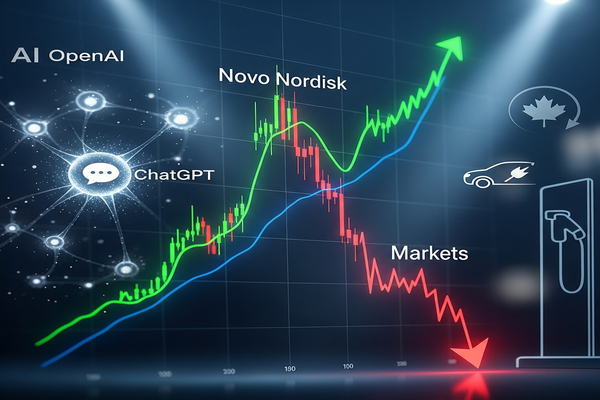
US stocks closed mixed as headlines from healthcare, tech and trade set the tone. The S&P 500 fell 0.1% while Novo Nordisk (NYSE:NVO) jumped 9.1% after a strong start for sales of its Wegovy weight loss pill. OpenAI said it will begin testing ads in ChatGPT, and Canada announced a tariff cut on Chinese electric vehicles capped at 49,000 units a year. Short term, markets reacted to company revenue signals and policy shifts. Over time, the moves could reshape profit mix in tech and auto sectors across the US, Canada, Europe and emerging markets. The timing matters because corporate results and trade rules influence near-term flows and capital spending decisions.
Market snapshot and equity flow
The S&P 500 closed down 0.1% in the most recent session. Traders weighed a mix of corporate updates and policy headlines against a cautious macro backdrop. Volatility remained contained as investors parsed discrete news rather than a single market-moving event. Equities in healthcare and select growth names drew the most attention as company-specific developments dominated sector performance.
Shares of Novo Nordisk (NYSE:NVO) led the headlines with a 9.1% rally after the company reported a strong early commercial performance for its Wegovy weight loss pill. The move highlights how positive sales momentum in a high-profile product can quickly shift investor positioning. The jump helped offset weakness elsewhere and underscored the market appetite for earnings and sales beats even when broader indices move sideways.
AI monetization debate: OpenAI to show ads in ChatGPT
OpenAI announced plans to test advertising in ChatGPT across its free tier and the $8 per month Go tier in the US in the coming weeks. The company said ChatGPT responses will not be influenced by advertisers while noting that ads will be influenced by the content of conversations. Personalization will be turned on by default with an opt-out option. Ads will appear separated from chats and will be labeled “Sponsored.” OpenAI said it will not sell conversation data to advertisers and will maintain privacy protections.
Investors and industry watchers read this as a concrete step toward monetization. OpenAI previously warned it could burn significant cash as it scales operations. The Information reported that the company could consume up to $115 billion by 2030. The ad test therefore signals an effort to diversify revenue beyond subscriptions and enterprise deals while the company explores long-term financial sustainability. A possible IPO remains on the table as well. The development matters globally because ad models and privacy norms differ across regions and could shape how large language models fit into existing media ecosystems.
Trade and autos: Canada trims tariffs on Chinese EVs
Canada will slash tariffs on Chinese electric vehicles as part of a broader trade deal. The government said imports from China will initially be capped at 49,000 vehicles a year, or under 3% of Canada’s new-car market. Ottawa expects the move to provide lower-cost options to Canadian buyers with import prices below $35,000. The announcement follows an expansion of Chinese EVs across global markets in 2024 and pressure on North American automakers from lower-priced alternatives.
The US approach differs. The Biden administration placed 100% tariffs on many Chinese-made cars last year in an effort to protect domestic production. That policy remains in place and has not been reversed. President Trump recently said he would welcome Chinese automakers to build factories in the US if they hire American workers. The contrast between Canadian tariff cuts and US protection measures creates a cross-border tension that market participants will watch closely. One open question is whether Chinese manufacturers respond by building local assembly facilities or joint ventures to avoid tariffs and expand market access.
Other corporate and legal developments
The Supreme Court agreed to hear Bayer’s (ETR:BAYN) appeal in litigation related to the weedkiller Roundup. The lawsuits allege the product caused cancer. Bayer’s CEO told reporters last year that an adverse outcome could force the company to remove Roundup from the market. The case has implications for product liability exposures and for companies with large legacy product portfolios. Legal outcomes in high-profile mass tort suits can influence investor risk assessments and reserve planning.
Walmart (NYSE:WMT) tapped supply chain executive David Guggina as US CEO. He replaces John Furner, who will move into the role of global CEO for the retailer, taking over from Doug McMillon. The executive shuffle signals a continuing focus on supply chain and operational execution at one of retail’s largest employers. Leadership changes at major retailers often prompt reappraisals of strategy, especially as companies balance inventory, pricing and margins in a slow growth environment.
In sports business news, the estate of the late Microsoft co-founder Paul Allen indicated plans to sell the Seattle Seahawks at some point to fund philanthropic goals. The team is not on the market today but is expected to be sold in the future. Forbes values the franchise at about $6.7 billion, a steep gain from an acquisition price that was reportedly under $200 million in 1997. The potential sale underscores how premium assets in leisure and media can deliver outsized returns over long periods and create headline risk for markets connected to sports franchise transactions.
What traders are watching next
Market participants will track several threads in the coming days. Company earnings and sales updates continue to drive single-stock moves. News on AI monetization and legal rulings can change sector risk premia quickly. Trade policy on autos and manufacturing will be watched for signs of supply chain reconfiguration and potential investment flows into North America. For now the market response has been measured with selective rallies and modest index moves. Investors will likely remain responsive to fresh corporate data and policy signals as they emerge.
This report focuses on information released in the most recent market session and public company statements. It is offered for informational purposes only and does not constitute financial advice.