










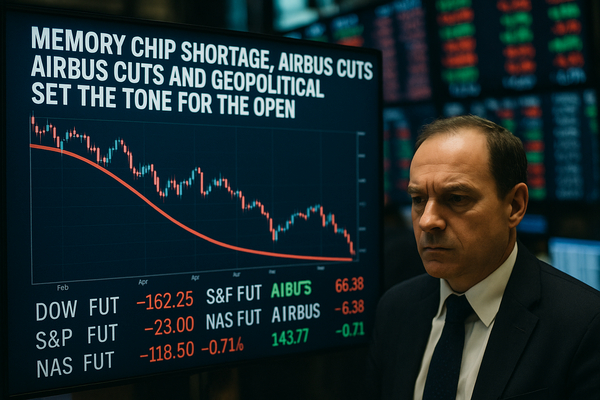
Markets head into the session focused on a severe memory chip shortage, a cut to Airbus delivery targets and a string of geopolitical and policy moves that are reshaping risk appetite right now. Short-term, traders will react to tightening supply for AI and consumer device components and to fresh statements from Moscow and Washington that could move safe haven demand. Longer term, supply constraints and regulatory shifts could recalibrate tech capital spending and aerospace production plans. The effects will be felt in the United States, Europe and Asia and will reverberate through emerging markets that supply raw materials and components. Historical pressure on inventories is now colliding with rising AI demand, making this a timely test for market liquidity and sector leadership.
Chip supply squeeze and tech demand
Memory shortages are driving price pressure and forcing buyers to compete for inventory
An acute global shortage of memory chips is driving companies that build AI systems and consumer electronics to fight for dwindling supplies. Prices are soaring for memory components that enable devices to store and process data. That pricing stress is already reflected in supplier inventory tightness and in procurement cycles that have shortened as buyers try to secure capacity for the next quarters. Technology platforms and hardware makers will be on watch for any commentary on component lead times and pricing. Alphabet (NASDAQ:GOOGL) will sit in focus after YouTube’s operational changes in Australia highlighted how regulatory and platform decisions can ripple through user behaviour and monetisation models. For markets, the immediate consequence is concentrated strength in suppliers and pressure on OEM margins when the cost increases cannot be passed through. In the medium term, strained supply can accelerate vendor consolidation and capital spending on memory capacity but it will also test earnings resilience for companies that rely on large memory footprints.
Aerospace under scrutiny
Airbus delivery cuts lift industry risk and point to production friction
Airbus (EPA:AIR) cut its 2025 delivery target by about 30 aircraft to roughly 790 units after a quality issue with fuselage panels on the A320 family. That move trims near-term supply expectations and underscores how single production problems can cascade into revenue timing and fleet deployment plans. Airlines are already facing scrutiny from nonoperating headlines such as pilot mental health reporting that can affect public confidence and regulatory oversight. The combination of slower aircraft deliveries and heightened operational scrutiny will be watched by parts suppliers, lessors and aircraft financing desks. In addition, any further revisions to delivery schedules could amplify volatility in aircraft leasing stocks and in regional markets where carriers were planning growth based on earlier delivery timelines.
Geopolitics and policy signals
Talks on Ukraine, US immigration pauses and Taiwan ties are weighing on risk sentiment
The Kremlin said President Vladimir Putin accepted some US proposals on Ukraine and signalled readiness to meet US negotiators multiple times. That statement reduces headline uncertainty for risk assets in the short run but it leaves many open items that markets will watch for detail. The US administration also paused immigration processing for applicants from 19 non European countries on national security and public safety grounds. That move can affect labour flows and remittance patterns for affected economies, with potential knock on effects for consumer demand in specific regions. Legislative action in Washington to require the State Department to review guidelines on engagement with Taipei drew a mixed reaction from Taiwan and China. Those developments can influence regional investor sentiment in Asia, especially for sectors exposed to cross strait trade and supply chains. Overall, markets will parse official language for clarity on next steps and for any signs of escalation or calming that might change currency and sovereign bond flows.
Emerging markets and commodity ties
Pemex pleas, natural disasters and central bank rows add pressure to local markets
It has been over a month since the head of Pemex made a public appeal for partners on projects meant to arrest falling production. The lack of immediate corporate responses highlights the challenges facing resource heavy companies that rely on external investment to fund output expansions. That dynamic is relevant for markets that price sovereign risk and energy sector credits in Mexico. Meanwhile, authorities on Sumatra are battling floods that have cost hundreds of lives and that have prompted appeals for central government support. Natural disasters of that scale can stress local budgets and plug demand into commodity markets for reconstruction materials. In Europe, the European Central Bank urged Italy to reconsider a parliamentary amendment asserting that national gold reserves belong to the people. That exchange adds an institutional governance angle that traders may treat as a caution on euro area policy cohesion and on Italian sovereign spreads if the debate escalates.
What traders will watch in the session
Data points, corporate updates and central bank chatter will determine near term positioning
Attention will centre on any granular comments about chip inventory and pricing from suppliers and buyers, and on further detail from Airbus about repairs and delivery cadence. Market participants will also parse any follow ups to the Kremlin announcement for signs of progress or pushback that could move risk appetite. Fiscal and immigration policy changes in the United States are likely to be priced into currency and regional equity flows if they remain in the headlines. In addition, traders will be sensitive to narratives around emerging market liquidity after the Pemex appeal and Indonesia’s relief funding needs. Finally, statements from central bankers and spokespeople that touch on policy frameworks, gold reserves or institutional independence could reweight fixed income and currency markets. The session will therefore be driven by a mix of supply shock headlines, corporate operational updates and policy signals that together will inform sector rotation and safe haven demand.
For the upcoming open, liquidity and order flow will determine how strongly the market reacts to each of these drivers. Short-term moves may be sharp when headlines land. Longer term, the combination of constrained memory supply, aerospace delivery changes and shifting policy signals can alter earnings and capital spending plans across multiple sectors. Traders will manage headline risk while watching for confirmation in company filings and official statements before repricing exposures.