







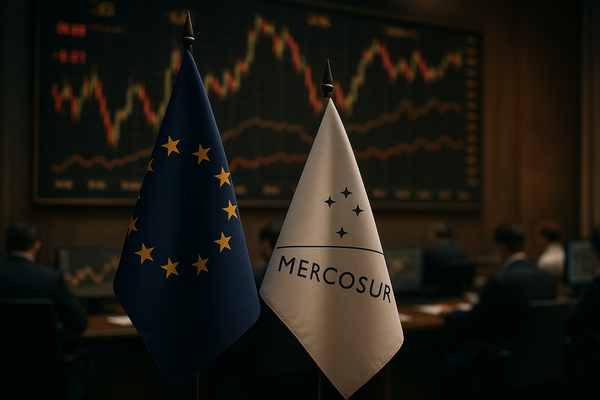
EU and Mercosur will sign a free trade agreement in Paraguay this Saturday, ending 25 years of talks and creating the European Union’s largest trade pact to date. The move matters now because it will start tariff reductions that affect commodity exporters and manufacturers in the near term and reshape supply chains over the long term. The deal has global reach for the US, Europe, Asia, and emerging markets. It follows prior trade deals that expanded market access but also sparked political debate.
What the agreement covers and the immediate timeline
Top EU officials will travel to Paraguay to formalize the pact after more than two decades of negotiation. The signing launches a formal ratification process in national parliaments and the European Parliament. Implementation will not be instantaneous. Tariff cuts and quota changes will be phased in. That timing matters for exporters and importers planning inventory and contract rollouts.
For Mercosur members, primarily Argentina, Brazil, Paraguay and Uruguay, the pact promises expanded access to the EU market for agricultural and industrial goods. For EU firms, it reduces barriers for cars, machinery and chemicals. The agreement is the biggest the EU has pursued, and it introduces new tariff schedules that will alter price competitiveness between regions.
Market and tariff implications
Markets will parse two channels. One is immediate sentiment. Global equity funds recorded their strongest weekly inflows in three and a half months, and US equity funds logged their largest weekly inflow over the same period. That inflow points to investor appetite that could support risk assets as trade opens. The second is the actual tariff effect. Lower duties on agricultural commodities could weigh on prices for producers that currently face higher EU tariffs. At the same time, reduced costs for intermediate goods in Europe can lower input prices for manufacturers.
Tariff news is already active elsewhere. The EU recently imposed duties on imports from China of fused alumina. The United States has signaled a 25 percent tariff on some semiconductors as a so called phase one action. Those measures will interact with the new EU-Mercosur pact by altering relative costs and redirecting flows. Companies and traders will compare tariff schedules and may shift sourcing toward the most cost-effective suppliers.
Regional winners, losers and currency impacts
In the near term, Mercosur agricultural exporters stand to gain. Soybean, beef and sugar sectors can expect expanded EU demand and better access. That should support export revenues and could push local currencies stronger versus the euro if trade flows accelerate. Over time the deal may encourage foreign direct investment to Mercosur countries as firms seek to capitalize on tariff advantages.
European manufacturers that import raw materials and intermediate goods from South America could see lower input costs. That could help margins for industrial exporters to third markets. However, domestic political reactions in several EU member states and Mercosur capitals could introduce delays. Ratification risks remain, and any postponement would mute market reactions.
How the pact fits broader policy moves and investor sentiment
The pact arrives while other policy and economic signals are influencing markets. Malaysia posted an advance estimate of 4.9 percent economic growth for 2025, beating forecasts and reinforcing demand narratives in Asia. Taiwan is positioning itself as a strategic AI partner in US tariff discussions. Such dynamics feed into supply chain strategies and investment allocations.
Monetary policy credibility also matters. The International Monetary Fund emphasized central bank independence and voiced support for current policy leaders. That backing can anchor expectations for interest rates and inflation, which in turn shapes currency and asset price responses to trade developments. Investors will weigh these macro signals alongside tariff changes when sizing exposures.
Corporate and sector effects to watch
Corporate earnings calendars and sector outlooks will factor in the new trade terms. One example from recent corporate news is Tata Technologies, which reported a near 96 percent quarterly profit plunge on a one time labour code charge, under the ticker NSE:TATATECH. That outcome shows how one off items can swamp operating trends. For sectors affected by the pact, companies will need to model both tariff reductions and the potential for increased competition from new entrants.
Materials and commodity sectors will be especially sensitive to shifting duties. Duties on fused alumina from China are one recent example of how trade measures can re-route flows and alter margins. Semiconductor supply chains face separate trade pressures from tariff policy in the US. Firms with complex international sourcing should update stress tests and scenario plans for tariff combinations across major markets.
Paths forward and scenarios for markets
If ratification proceeds smoothly, expect a phased improvement in trade volumes and a period of recalibration in commodities and industrials. Currency moves could favor Mercosur currencies and support commodity exporters. If ratification stalls, political uncertainty will lead to muted investment shifts and potential repricing of risk assets.
Investors will monitor fund flows, macro data and follow up tariff actions closely. The deal does not change interest rate or inflation dynamics on its own. However, by altering trade cost structures and external demand, it adds another variable for policy makers and markets to assess. For now it is a major trade milestone with tangible near term implications for exporters and manufacturers and longer term potential to redirect trade patterns across Europe, the Americas and beyond.
Overall, the EU-Mercosur signing is a timely development that intersects with current tariff measures and global fund flows, and it will be a key variable for market participants as they reassess trade exposures and supply chain strategies.