










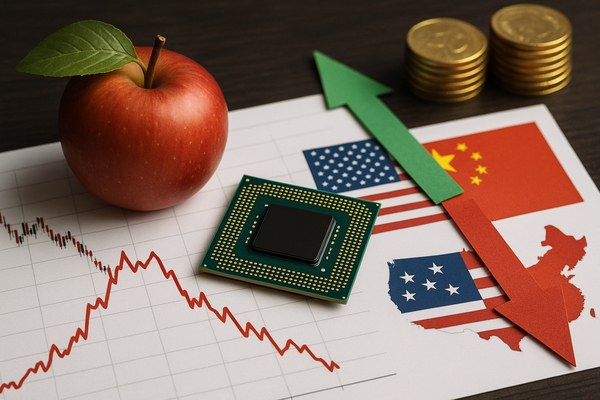
Apple in Focus: recent share weakness, strong China holiday iPhone sales, and an upcoming India antitrust hearing are converging with a booming AI chip cycle that is reshaping supplier flows and trade policy. Apple (NASDAQ:AAPL) closed at $255.53 after a 1-month slide of 6.63% and a year-to-date drop of 5.71%, while its 1-year total shareholder return stands at 11.61%. Short term, the antitrust hearing on Jan. 27 and China sales datapoints will move sentiment. Long term, AI-driven semiconductor demand and tariff actions affecting AMD (NASDAQ:AMD) and NVIDIA (NASDAQ:NVDA) will influence supply, margins and regional investment. This matters globally — from U.S. earnings to Taiwan foundry capacity and China import checks — and echoes last year’s chip shortages and hype around memory ramps.
Apple’s signal: softer trading, strong China sales, and regulatory noise
Apple (NASDAQ:AAPL) shows mixed market signals. The stock recently closed at $255.53. One-month returns were down 6.63%. Year-to-date performance fell about 5.71%, yet the 1‑year total shareholder return sits at 11.61%. That contrast points to short-term profit-taking rather than an outright collapse in fundamentals.
On the demand side, holiday iPhone sales in China topped rivals during an otherwise weak market. At the same time, Apple faces fresh regulatory pressure in India: a key antitrust hearing is slated for Jan. 27 and reports say Indian penalty rules may use global revenue in fines — a premise Apple disputes. The timing makes this a near-term catalyst for volatility in revenues and legal expense disclosures.
AI chip boom, foundry wins and tariff friction
The chip cycle is accelerating. Taiwan Semiconductor (NYSE:TSM) jumped after a strong Q4 as AI chip demand surged. Micron (NASDAQ:MU) warned of an “unprecedented” memory shortage and moved to buy Powerchip’s P5 Taiwan fab for $1.8 billion, while breaking ground on a planned $100 billion U.S. megafab complex.
Tariff policy is now a material supply shock. Reports cite a 25% tariff on certain AMD (NASDAQ:AMD) and NVIDIA (NASDAQ:NVDA) chips; other commentary references moves to push foreign memory makers toward U.S. capacity with steep tariffs. Intel (NASDAQ:INTC) has gotten fresh analyst attention and price-target resets as foundry wins and new chip launches feed optimism; the stock had gained roughly 26.27% year to date in one uptick of coverage. Meanwhile, Chinese customs action has paused H200 shipments from NVIDIA (NASDAQ:NVDA), forcing suppliers to halt output on affected lines.
These developments create immediate traffic jams for hardware customers and longer‑term shifts in capital spending. Foundries and equipment suppliers such as KLA (first mention) are seeing upgrades on stronger process-control demand. The net effect will show up in order books, backlog metrics and regional capex plans over the coming quarters.
Market implications, positioning and what to watch next
Investors and corporate planners should track a short list of concrete indicators:
- Regulatory dates: India antitrust hearing for Apple on Jan. 27. Any ruling or guidance could affect disclosure and fines calculations.
- Trade moves and customs actions: the reported 25% tariff and China’s pause on H200 shipments will influence near-term supply and inventory strategies.
- Capacity announcements: Micron’s $1.8 billion Taiwan fab deal and the planned $100 billion U.S. megafab are direct responses to AI-driven memory tightness.
- Earnings updates: watch Q4 and guidance from chip suppliers, foundries and Apple for revenue mix commentary, margin impacts and backlog figures.
In addition, keep an eye on broader signals such as backlog growth at AI-focused suppliers and export-clearance notices that could widen or narrow the short-term gap between demand and supply.
Key takeaways:
- Apple’s pullback is timing-sensitive: Jan. 27 India proceedings and China sales data are near-term drivers of sentiment.
- Tariffs and customs moves (including a reported 25% levy and H200 shipment pauses) are already altering supply chains and forcing capacity shifts.
The confluence of regulatory risk for Apple (NASDAQ:AAPL), trade measures hitting AMD (NASDAQ:AMD) and NVIDIA (NASDAQ:NVDA), and a capital-intensive push from memory suppliers like Micron (NASDAQ:MU) means the next several weeks will be heavy with actionable corporate disclosures. Companies, analysts and regional policymakers will all react to concrete datapoints — earnings, shipping notices and hearing outcomes — rather than rhetoric. That makes the immediate calendar and incoming numbers essential for assessing where the market goes next.