









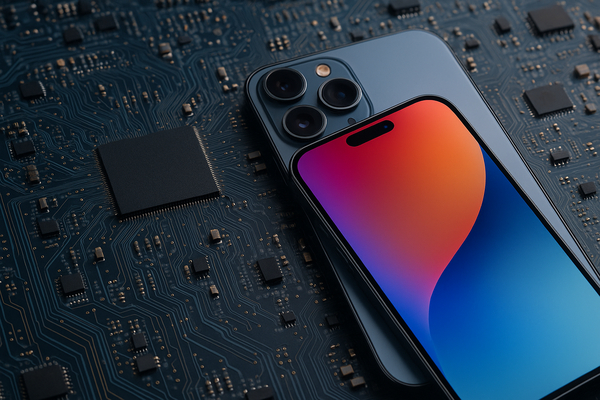
Apple’s iPhone 17 Surge Propels chip deals and device-market shifts. Apple Inc. (NASDAQ:AAPL) is hitting fresh highs as iPhone 17 demand accelerates, driving short-term investor momentum and near-term supply chain reallocation. In the short run this matters for stocks, suppliers and foundry capacity; over the long run it reshapes chip sourcing, memory priorities and enterprise AI spend. The move is global — higher iPhone volumes lift suppliers in the US, Europe and Asia while pressuring memory markets in emerging markets. Compared with prior iPhone cycles, the 2025 upswing is more AI‑anchored, pushing chipmakers to shift from consumer SKUs to datacenter and HBM demand.
Apple’s sales surge, stock reaction and the Intel whisper
Apple (NASDAQ:AAPL) hit a fresh intraday high and extended a multi‑day rally after reports and supply‑chain checks suggested stronger iPhone 17 deliveries. Loop Capital raised its price target to $325 from $315, citing stronger unit and ASP assumptions. The stock has climbed roughly 40% over the past six months, and the recent stretch of gains underscores renewed investor faith in product momentum and services leverage.
Those gains ripple through the chip supply chain. Intel (NASDAQ:INTC) traded up as much as 8.7% on reports it could supply Apple with M‑series chips built on its 18A node as early as 2027. Intel also signaled capacity moves — a US$208 million packaging and test expansion in Malaysia — that would support broader foundry ambitions. Pat Gelsinger has flagged industrial urgency around domestic chip capacity and government investment. The combination of Apple demand and Intel’s foundry push is re‑pricing the prospect of non‑NVIDIA compute on Apple’s roadmap and altering OEM sourcing dynamics.
Key takeaway: Strong iPhone 17 demand is catalyzing immediate stock gains for Apple and short‑term supplier wins, while accelerating longer‑term reshoring and foundry conversations.
AI infrastructure and memory: Nvidia, Broadcom, AMD and Micron responses
NVIDIA (NASDAQ:NVDA) remains the focal point in AI compute. The company published data showing new servers can speed certain AI models by 10x, underpinning why hyperscalers continue to centralize on NVIDIA‑optimized stacks. Yet competition is intensifying. Amazon, Google and others are building custom silicon — Google’s TPUs and Amazon’s new Trainium 3 are explicitly framed to reduce training costs and pressure NVIDIA’s growth mix.
Broadcom (NASDAQ:AVGO) is also in the frame: Morgan Stanley has argued Broadcom could outpace NVIDIA in AI processor revenue growth in 2026 due to supply constraints. AMD (NASDAQ:AMD) picked up positive analyst attention — TD Cowen named it a Best Idea for 2026, pointing to the Helios rack‑scale platform and a large cloud deployment (Vultr’s planned 24,000‑chip Ohio AI cluster backed by a ~US$1 billion project) that will push AMD Instinct adoption.
Memory is the other bottleneck. Micron Technology (NASDAQ:MU) announced it will exit its consumer Crucial business and focus on advanced memory for AI datacenters. Micron will keep Crucial shipments flowing through fiscal Q2 (ending February 2026) while it reallocates capacity. Separately, plans surfaced for Micron to invest US$9.6 billion in a Japan plant to target HBM supply for AI — a clear sign that HBM is a strategic choke point as model sizes and inference deployments grow.
Key takeaway: The AI compute arms race is driving a two‑track market: hyperscaler custom silicon and continued NVIDIA dominance, while HBM and advanced memory become the tight resource that will shape vendor fortunes.
Device markets, peripherals and enterprise software linkages
Rising device demand and remote/gaming usage are lifting adjacent markets. The U.S. wireless mouse market is forecast to grow from US$635.11 million in 2024 to US$1.08 billion by 2033 — a CAGR of 6.11% — driven by ergonomic designs, advanced wireless tech and gaming mouse demand. The U.S. laptop market is expected to reach US$63.77 billion by 2033 at a 4.05% CAGR, supported by 5G and AI‑enabled features that make laptops more central to enterprise and education workflows.
Regulation and software matter too. The FDA’s heightened scrutiny of wearables such as WHOOP signals heavier compliance costs for niche device makers that mix wellness with medical claims. In enterprise software, Oracle (NYSE:ORCL) and Palantir (NASDAQ:PLTR) are active: Oracle draws bullish analyst notes on cloud and AI service demand, while Palantir launched Chain Reaction to accelerate AI data‑center construction. Microsoft (NASDAQ:MSFT) reports of easing AI sales quotas have produced short‑term volatility, showing how enterprise AI monetization timelines are still being tested.
Hardware and software are tying closer. Digital Check certified scanner support for macOS 26 and Apple M4 processors, which is a small but telling example: platform upgrades across macOS, silicon and peripheral certification matter for corporate buyers and vertical OEMs.
Key takeaway: Growing device and peripheral markets — from laptops to high‑performance mice — will sustain supplier revenue even as enterprise software and regulatory shifts alter monetization and feature roadmaps.
Actionable summary:
- Apple’s iPhone 17 demand is reigniting supplier flows and investor confidence — watch component orders and ASP trends closely.
- Advanced memory (HBM) and packaging capacity are the next structural constraints — Micron’s pivot and Japan investment are a clear signal.
- AI compute will bifurcate: hyperscalers’ custom silicon vs. NVIDIA‑centered stacks — expect more M&A and partnerships in 2026.
- Short‑term stock moves (Intel, Broadcom, AMD, NVIDIA) reflect narrative shifts; longer‑term winners will align capacity with software demand.
For market participants, the immediate window is about supply and demand reactions: inventory, foundry commitments and memory allocation. Over the next 12–36 months, expect capacity investments, regional plant builds and a clearer picture of who can reliably supply both consumer and AI datacenter needs at scale.