










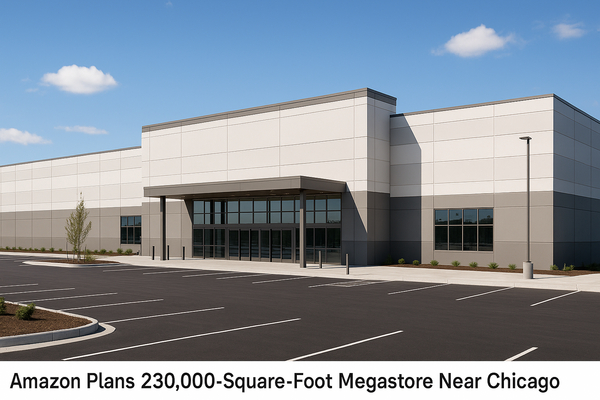
Retail and Auto-Tech: Amazon’s Megastore and Tesla’s FSD Insurance Move are taking center stage. Amazon (NYSE:AMZN) is developing a 230,000-square-foot store to broaden its physical retail footprint. Tesla (NASDAQ:TSLA) is seeing validation for its Full Self-Driving product as Lemonade (NYSE:LMND) cuts insurance rates by 50% for FSD miles. These developments matter now because retailers race to lock in omnichannel shoppers this year, while autonomous driving progress is changing risk models for insurers and fleet operators. Short-term: consumer traffic and logistics costs will react. Long-term: store formats, network economics and autonomous insurance pricing could redraw competitive advantages across the US, Europe and emerging markets.
Amazon’s retail expansion: a big bet on physical scale and new checkout tech
Amazon (NYSE:AMZN) is planning a 230,000-square-foot store outside Chicago — its largest yet — signaling a push into big-box retail. The concept will combine groceries, household merchandise and general retail items in a single location. Amazon has also upgraded its Just Walk Out and RFID-enabled checkout lanes to support pop-up and festival retail, lowering per-store staffing needs and accelerating store rollout.
Why size matters: a 230,000 sq ft footprint approaches the scale of traditional big-box rivals. The new store could increase on-site SKU depth and sales density. In Brazil, where B2C ecommerce grew 9.9% to $64.09 billion in 2025, larger physical hubs can reduce last-mile costs and improve inventory turns — metrics that directly affect gross margin.
Competition and cost pressure are quantifiable. Home Depot (NYSE:HD) and Lowe’s (NYSE:LOW) dominate US home improvement; Amazon’s broader general-merchandise push could reallocate share. Amazon’s store experiment arrives as CEO Andy Jassy warns of tariff-driven price pressure starting in 2026, a development that will squeeze sellers and could force retailers to raise prices or absorb costs. For investors and operators, unit economics — sales per sq ft, labor as percentage of sales, and inventory days — will determine whether the concept is accretive.
Tesla’s FSD momentum and insurance validation
Tesla (NASDAQ:TSLA) remains a focal point for the market’s view on autonomous driving. Shares last closed at $431.44, down 1.8% over seven days and down 11.7% over 30 days, but still up 198.7% over three years. Market chatter around Tesla’s robotaxi and Optimus robotics programs continues to influence sentiment ahead of quarterly results.
Insurers are quantifying risk differently. Lemonade (NYSE:LMND) announced a 50% rate cut for miles driven under Tesla’s Full Self-Driving (FSD) product and launched a dedicated Lemonade Autonomous Car insurance product. LMND shares were up 152% over the past year and hit a new three-year high on the news. The headline numbers matter: a 50% rate reduction signals that at least one AI-native insurer sees statistically lower exposure from FSD usage, potentially lowering cost of ownership for FSD users who currently pay $99 per month for the service.
For Tesla’s financial model this has direct implications. If FSD usage grows and insurers price miles differently, Tesla could see reduced insurance friction for buyers and higher FSD adoption rates — metrics that influence average revenue per vehicle. Morgan Stanley and other sell-side firms are watching FSD monetization and Dojo supercomputing cycles as key drivers for TSLA multiple expansion. However, Elon Musk has tempered timing expectations, saying production ramps for Cybercab and Optimus will be slow.
AI funding, cloud demand and advertising rivalries
AI is pushing capital flows and platform competition. OpenAI is reported to be courting at least $50 billion from Middle East sovereign investors and targeting a valuation between $750 billion and $800 billion. Such a capital injection would accelerate compute demand for cloud providers and boost enterprise AI spend.
Cloud and advertising winners are measurable. Amazon’s cloud and retail data assets position it to compete for ad dollars that Trade Desk (NASDAQ:TTD) also chases. TTD has faced analyst downgrades and platform-transition concerns; its 90-day share return was down roughly 36.6% from prior peaks. As advertisers reallocate budgets to retail media and cloud-driven measurement, Amazon’s combined retail and cloud capabilities create a cross-sell opportunity where ad gross margins can exceed product margins.
Anthropic’s office expansion in New York and OpenAI’s capital-raising efforts both point to rising AI headcount and data-center growth. For infrastructure providers and energy companies, the outcome is quantifiable: higher server deployments, longer-term power demand, and greater need for specialized chips. Nvidia-led GPU demand was a theme at Davos this week, and enterprise cloud commitments will show up in quarterly capex plans and revenue guidance for major cloud vendors.
Logistics, emerging markets and portfolio flows
Retail expansion and autonomous adoption ripple through logistics. UPS (NYSE:UPS) is pivoting away from Amazon-heavy volume toward higher-margin healthcare and specialized logistics; analysts note UPS shares have risen as the company rebalances its mix. Shifts in parcel economics will be measured by package volumes, average yield per package and network utilization.
Emerging markets also matter. Amazon’s push into India and Latin America is part of a larger global revenue story. A recent note highlighted rising international revenues and improving profitability for AMZN in emerging markets. Brazil’s ecommerce growth to $64.09 billion shows where upside can come from. For portfolios, regional allocation matters: Polen Global Growth’s Q4 2025 return of -2.5% lagged the MSCI ACWI, but the fund’s activity included new Tencent and Spotify positions and a noted drag from Oracle — illustrating how active managers are repositioning around tech and platform exposure.
Capital flows into AI ventures and start-ups could also re-rate private valuations. Blue Origin’s plan to deploy a 5,408-satellite constellation and OpenAI’s potential $50 billion raise are examples of capital intensity that will influence public market sentiment for companies tied to space, connectivity and compute.
What the market is watching next
Short-term market moves will track concrete data points: Amazon’s store opening timeline, unit economics per square foot, tariff pass-through timing, Tesla’s Q4 results and FSD adoption metrics, Lemonade’s loss ratios on autonomous insurance, and OpenAI’s fundraising milestones. Each of those items will show up as measurable changes in revenue guidance, margin profiles or share-price volatility.
Investors and managers will watch the intersection of physical retail scale, AI-driven product adoption and logistics economics. The immediate effect is visible in share performance and insurance pricing; the longer-term effect will be revealed in margins, capital spending and market share data across the US, Europe and high-growth emerging markets.
Note: This commentary is informational and does not constitute investment advice.