










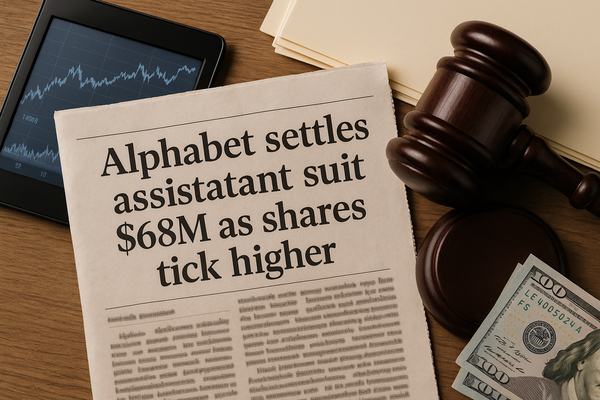
Google pays $68 million to settle claims its voice assistant recorded users. The settlement arrives as Alphabet shares trade in a buy range after a 20% run since late October, and as analysts flag faster AI monetization and Waymo rollouts for 2026. In the short term, the $68M payout and renewed regulatory scrutiny press on margins and reputational risk; in the long term, stronger ad monetization of AI and Waymo commercialization could lift revenue and operating leverage. Globally, the settlement and European DMA proceedings sharpen compliance costs across the U.S., EU and Asia, while Google-funded initiatives such as a US$4 million ONE Data grant highlight firms’ rising focus on data governance in emerging markets. Compared with past privacy cases, the $68M figure is small relative to Alphabet’s US$1.5+ trillion market cap but timely: shares at roughly US$333 are up about 1.6% on the day, and analysts from TD Cowen reaffirm a Buy with a US$355 target. Investors weigh near-term legal and capex drag against multi-year AI and autonomous-revenue paths that mirror big-cap tech cycles since 2018.
Alphabet market moves, legal costs and analyst signals
Alphabet’s stock closed near US$333.25–US$333.59 in the latest sessions, up roughly +1.6% day-over-day. The company disclosed a US$68 million settlement over alleged Google Assistant recordings; management did not admit wrongdoing. That one-off hit is modest next to Alphabet’s trailing-12-month revenue of roughly US$320 billion (2025 full-year), but it matters for headline risk and regulatory optics.
TD Cowen reiterated a Buy on GOOGL on Jan. 22 with a US$355 price target, citing accelerated Waymo commercialization in 2026. Market commentary also notes that Google-linked stocks climbed about 20% since late October, while parts of the open-AI ecosystem declined near 20%, according to Niles Investment Management founder Dan Niles. Trading volumes have picked up as funds reshuffle into AI beneficiaries; GreensKeeper Value Fund cited Alphabet among 2025 winners in its Q4 update after reporting a net return of +0.4% for the year.
AI chips, funding and the cloud: who benefits from big-cap backing
Investor appetite for AI silicon and cloud capacity shows in several recent financings. Ricursive, an AI chip startup, hit a US$4 billion valuation two months after launch. Synthesia closed a US$200 million round at a US$4 billion valuation with participation from Alphabet and Nvidia, underscoring cross-capital flows into AI content tooling.
Nvidia’s strategic moves also ripple through the market. Nvidia expanded its partnership with CoreWeave and bought Class A common stock at US$87.20 per share, a deal that followed CoreWeave’s premarket jump to about US$103 per share (up ~11%). CoreWeave bond prices moved too: roughly US$240 million of bonds due 2030–2031 traded and rose 2%–3% on the news, highlighting how equity injections can tighten credit spreads for capital-intensive AI cloud providers.
Ad platforms, AR/VR and Meta’s metrics
Ad monetization remains a key comparator for investors. Meta Platforms shares traded near US$669.19 in morning action, up about +1.6% as Q4 earnings approached. Wall Street expects robust ad growth but cautious commentary on AI spend: analysts at Rothschild & Co Redburn upgraded Meta to Buy and set a US$900 target, while Wells Fargo kept an Overweight rating and trimmed its target to US$754 from US$795.
Meta’s hardware and XR metrics also provide numbers investors use to triangulate long-term returns. Industry reports project more than 5 million shipments of AI-enabled smart glasses by 2025, and Meta’s Reality Labs losses remain a clear drag on margins. Cathie Wood’s ARK trimmed roughly US$8 million of Meta stock in the run-up to earnings, a quantifiable sign that active managers are rebalancing ahead of capital-intense product cycles.
Data centers, power deals and supply-chain signals
Spotlight on infrastructure: Clearway Energy agreed three long-term power purchase agreements with Google totaling 1.17 GW of clean energy across Missouri, Texas and West Virginia. Clearway’s shares trade at about US$33.60, with a 30-day return of +6.87% and a 90-day return near +12.15%. Those PPAs lower operating cost volatility for hyperscalers and reduce a key barrier to data-center expansion.
On the supply chain side, Celestica faced investor concern over potential changes to Google TPU assembly work, driving stock-specific volatility. That follows a broader pattern where contract shifts can move tens to hundreds of millions in revenue between suppliers. At the same time, Google’s ONE Data and Rockefeller Foundation-backed US$4 million Development Finance Observatory signals corporate-led investment in data transparency—an operational cost but also a reputational investment that can ease market access in emerging markets.
Content, subscriptions and streaming metrics that matter for platform economics
Content owners remain an intersecting theme. Netflix reported memberships above 325 million and cited 16% revenue growth with roughly 30% operating-profit growth in Q4 2025, but the stock fell over 5% on the day of earnings as investors parsed margin drivers and acquisition plans. Analysts at PhillipCapital moved Netflix to Accumulate from Sell with a new price target of US$100 after the run of subscriber and ad-business metrics.
Those content trends matter to companies deploying AI for ads, personalization and game-like engagement. Higher server-hour demand from streaming, game servers and generative-AI workloads feeds back into chip demand and the valuation gap between hardware suppliers, cloud operators and software platforms.
Bottom line: the US$68 million Assistant settlement is small relative to Alphabet’s scale, yet timely. Shares around US$333 reflect investor focus on AI monetization, Waymo commercialization, and the infrastructure funding needed to scale models. Short-term, legal and capex headlines can dent sentiment; long-term, confirmed analyst convictions—Buy ratings and price targets from firms like TD Cowen and Rothschild—underline expectations that ad revenue, autonomous services and AI tooling will drive durable top-line growth.
