










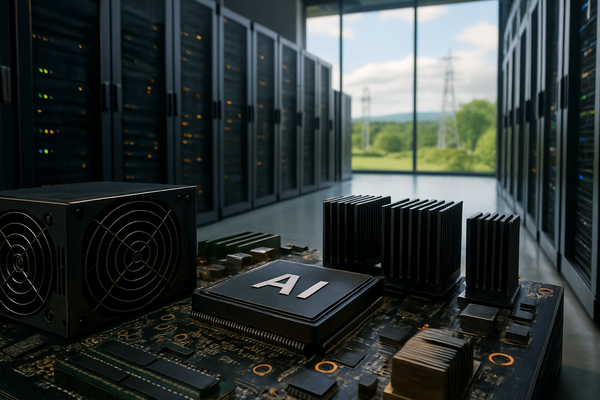
AI hardware and data-center infrastructure buildout is driving an industrial sprint. Nvidia (NASDAQ:NVDA) and hyperscalers are buying GPUs and memory at record rates. Samsung (KRX:005930) is starting HBM4 production next month. Utilities and developers are lining up gigawatts of power with deals like Alphabet’s (NASDAQ:GOOGL) long-term energy agreements. Short term, China approvals and supply bottlenecks are moving stocks and contracts. Long term, the world is re-pricing land, power and silicon for an era of continuous training and inference. This matters in the US, Europe, and Asia because chips, memory and local power determine who hosts the next generation of AI.
Chips and memory: customers, capacity and a renewed supply squeeze
Semiconductor demand is no longer episodic. It is continuous. NVIDIA (NASDAQ:NVDA) remains the locomotive of AI compute. Jensen Huang has framed AI as the largest infrastructure buildout in human history, and the market is responding. Reports that Chinese firms can prepare orders for Nvidia’s H200 and that Huang plans a China trip pushed NVDA shares and re-opened a key consumer of GPUs.
Foundries and memory makers are racing to keep pace. Taiwan Semiconductor (NYSE:TSM) now ranks Nvidia among its largest customers. Samsung (KRX:005930) told Reuters it will start HBM4 production next month to supply Nvidia, a speed-up that matters because high-bandwidth memory is the limiting factor for next‑generation accelerators. Micron (NASDAQ:MU) remains central too; analysts warn a memory shortage could persist into 2027, keeping pricing power with suppliers and weighing on OEM deliveries.
Competition matters. AMD (NASDAQ:AMD) has re-emerged as a credible alternative, and Broadcom (NASDAQ:AVGO) is winning bespoke AI networking and accelerator deals with hyperscalers. Meanwhile Intel (NASDAQ:INTC) has signaled it can’t fully meet AI data-center demand, and that shortfall showed up in a sharp share-price reaction. The near-term consequence: customers hedge across vendors, while suppliers stretch capacity and prioritize the highest-margin orders.
Power and real estate: gigawatts are the new scarce resource
Chips need power. More AI compute equals more gigawatts. Jensen Huang’s comments in Davos about construction and electricity aren’t rhetoric. They are a literal blueprint. Hyperscalers are signing long-duration energy deals and booking land close to transmission and substations.
Alphabet (NASDAQ:GOOGL) has been linked to multi-decade power contracts, and reports highlight a NextEra Energy (NYSE:NEE) style model of long-term utility deals to guarantee data-center power. Companies with large, flexible power footprints are suddenly strategic partners. Riot (NASDAQ:RIOT) converted a mining-focused campus into an AMD (NASDAQ:AMD) AI lease for 25MW, showing how energy-rich sites are being repurposed. Bitfarms (NASDAQ:BITF) is accelerating a pivot from pure crypto mining toward high-performance computing, chasing the same economics: cheap, long-term power and scale.
That combination creates a construction boom. The industry will hire electricians, concrete crews and transmission engineers. It will also force planning authorities and utilities to re-think permitting and grid upgrades at a scale not seen since earlier cloud expansions.
Hyperscalers and cloud providers: landlords, builders and vertical integrators
Hyperscalers are not passive customers. Oracle (NYSE:ORCL), Amazon (NASDAQ:AMZN), Alphabet (NASDAQ:GOOGL) and Meta (NASDAQ:META) are vertically integrating or signing exclusive supply and power deals to secure capacity. Oracle’s push into GPU-as-a-service and its role in the TikTok US joint venture underscore how cloud providers want to be the landlords of data gravity—hosting the biggest models and the most valuable data.
AWS and Google Cloud oscillate between outsourcing components and building raw capacity. Google’s TPU assembly changes and reported supplier shifts show the cloud giants will optimize both cost and control. At the same time, REIT landlords and data-center operators like Equinix (NASDAQ:EQIX) and Digital Realty (NYSE:DLR) are positioned to capture outsourcing demand from enterprises that don’t want to own the full stack.
Those strategic choices have market consequences: cloud CAPEX rises, private data‑center valuations reset, and enterprise buyers face a choice between on‑premises control and hyperscaler scale.
Market signals and what investors and managers should watch
News is already moving markets. NVDA’s stock reacts to China import signals and policy; Nvidia’s $150 million investment in Baseten shows the company is extending its influence down the software stack. Intel’s miss on AI-driven demand led to a painful stock drop, while AMD and Broadcom saw relative strength as investors re-price winners and laggards.
Supply constraints in memory and rising DDR6/DDR7 costs are feeding product-price inflation for GPUs and servers. Reports that AIB partners may raise GPU prices reflect those upstream pressures. That matters because rising component costs lengthen replacement cycles and squeeze OEM margins.
In practical terms, the AI buildout is creating a multi‑layered buying market: accelerators and memory at the chip level; servers, racks and networking at the hardware level; power and real estate at the site level; and long-term service contracts at the hyperscaler level. Winners will be companies that secure scarce inputs—foundry slots, HBM supply, land with available power and long-term utility contracts. Execution risk will penalize those who can’t convert demand into installed capacity.
This is an industrial story as much as a technology one. The next 24 months will prove whether the industry can move from hype to routine delivery. For governments, utilities and corporate procurement teams, the takeaway is simple: treat chips, memory and power as strategic resources, not consumable inputs. This article is informational and not investment advice.