










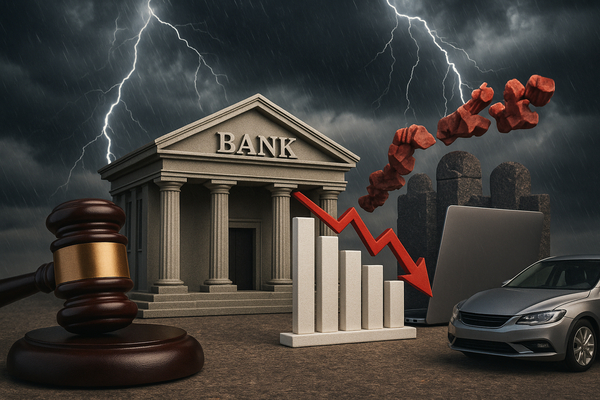
Trump sues JPMorgan for $5 billion. The lawsuit escalates a political fight into a legal test that is reshaping market attention on banks, payments, and large corporates today. In the short term it is driving volatility across financial names and forcing boards to re-evaluate reputational and counterparty risk. Over the longer term the case, together with a string of regulatory probes and trade interventions, is altering due diligence, capital planning, and supply chain choices in the US, Europe and Asia. Investors are watching banks in New York, chipmakers in Taiwan and China, and carmakers in California for signs of contagion and resilience.
The theme is immediate because multiple high-profile headlines landed in a compressed window. President Donald Trump filed a $5 billion suit against JPMorgan Chase & Co. (NYSE:JPM) alleging political “debanking.” The complaint names CEO Jamie Dimon and revives a debate over whether banks acted for political reasons when cutting ties after the January 6, 2021 events. JPMorgan has said the claim lacks merit. Market reaction was swift. Financial-sector news surged, and the NYSE financial index moved while analysts rehashed deposit, net interest income and reputational assumptions for major banks. Jamie Dimon’s widely reported $43 million pay package and JPMorgan’s public goal of $103 billion in net interest income for 2026 add context to how material litigation and politics can be for a lender whose franchise depends on public trust and regulatory goodwill.
Regulatory probes are stacking up elsewhere. The Justice Department is reported to be investigating whether Tesla, Inc. (NASDAQ:TSLA) overstated EV range claims, even as Tesla begins robotaxi rides without in-car safety monitors in Austin. That combination of enforcement risk and ambitious commercial rollouts is creating a near-term news flow that swings auto and mobility stocks. Tesla’s headlines dominated globalwire coverage, while safety regulators and insurers are assessing potential liabilities. Separately, trade and export rules are pressuring chipmakers: Washington faces bipartisan pressure over allowing advanced AI chip exports to China even as Nvidia (NASDAQ:NVDA) and peers see surging demand for datacenter hardware. Export scrutiny is accelerating strategic decoupling decisions by hyperscalers and semiconductor firms, and it is sharpening geopolitical costs for companies with cross-border supply chains.
TikTok’s US solution also crystallized political legal risk for tech platforms. ByteDance agreed to a majority American-owned JV that will operate TikTok in the United States with Oracle (NYSE:ORCL), Silver Lake and others as managing investors. US and Chinese sign-off on that structure neutralized a looming ban, but it set a precedent. Lawmakers and executives now expect remedy frameworks that include governance controls, algorithm security and data localization. That reality is shifting how cloud providers, ad platforms and social media companies budget for compliance and contract with governments.
These stories are not isolated. The media attention counts are concentrated in a few names. Tesla and Nvidia each produced heavy coverage, with Tesla among the most-reported tickers and Nvidia drawing attention for both its China access challenges and product rollouts. Apple (NASDAQ:AAPL), Microsoft (NASDAQ:MSFT) and Alphabet (NASDAQ:GOOGL) also featured repeatedly as regulators, national security concerns and trade policy topics intersect. The aggregate effect is greater volatility in technology and financial sectors than in plain-vanilla cyclicals.
Sectors feeling the impact vary by mechanism. Financials see direct legal and political exposure because litigation and policy debates cut to licensing, deposit migration and merchant services. Payments firms and card networks are watching policy proposals such as a proposed 10 percent cap on credit card rates that the president mentioned; even if unlikely to pass, the idea weighs on net interest and interchange assumptions for banks and card issuers. Technology and cloud names face compliance and export risk. Semiconductors carry both trade friction and supply-side tightness: export controls and elevated memory costs are combining with record AI demand to tighten margins and reorder partner networks. Autos blend regulatory enforcement with product liability and safety scrutiny as autonomous and robotaxi rollouts accelerate. Energy and data center infrastructure firms are indirectly exposed through power and permitting bottlenecks created by rapid AI buildouts.
Companies are responding in observable ways. Banks are publicly reinforcing compliance and customer-acceptance processes while analysts re-rate loan growth and fee assumptions. Cloud and hyperscale operators are issuing power purchase agreements and sovereign cloud offers designed to limit political friction, as seen in recent multi-year PPAs and sovereign data center initiatives. Semiconductor firms and their customers are accelerating geographic diversification of manufacturing and procurement. EV makers are engaging regulators proactively and re-examining product liability reserves. Corporates are also prioritizing legal and government affairs resources, adding scenario planning for sanctions and export restrictions.
For market participants and corporate managers, several risk-management approaches are emerging as practical responses. First, increase legal and regulatory stress-testing of cash flow models and counterparty exposure to capture litigation and de-banking scenarios. Second, prioritize multi-jurisdictional operational capacity by building alternative data routes, localized cloud options, and manufacturing footprints that reduce single-country dependencies. Third, enhance governance disclosures and reputational playbooks so boards and C-suites can move rapidly in public-facing disputes. Fourth, sharpen capital and liquidity cushions where political headlines can trigger deposit shifts or contract terminations. Finally, expand engagement with policy makers and industry coalitions to shape rule-making rather than merely react to it.
These approaches are informational, not investment advice. Their purpose is to show how managers, analysts and risk teams are adjusting assumptions that underpin valuations. Litigation and regulatory actions are immediate drivers of headline risk and can persist as structural costs if they change rules of market access or require sustained compliance spending. Companies with clear governance, diversified footprints and contingency playbooks tend to reduce execution drag from legal shocks. Conversely, firms with concentrated counterparties or high regulatory visibility will face ongoing earnings and multiple compression until legal outcomes stabilize.
In sum, politics and law are actively re-pricing a swath of corporates. The $5 billion suit against JPMorgan catalyzed fresh attention on banking vulnerability to political conflict. Parallel probes and policy moves are reshaping strategic choices at Tesla, Nvidia, Oracle and other large-cap names. Markets are reacting in real time, and executives are reallocating resources to legal, compliance and geopolitical resilience. That reallocation is likely to influence capital spending, M&A appetite and partner selection well into the year.