









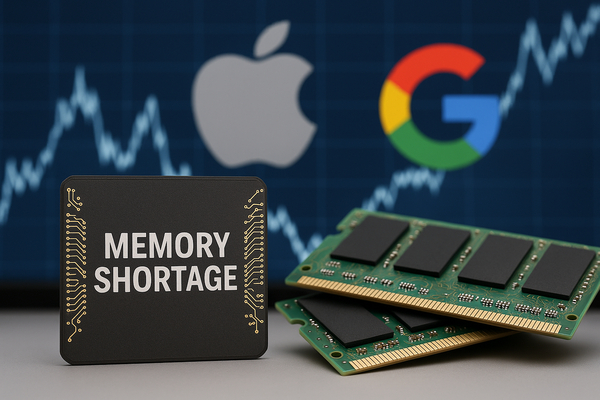
Memory squeeze and Apple’s Gemini pact reshape tech near‑term prospects. Global memory chip shortages are driving up prices and forcing consumer device makers to raise prices, while Apple (NASDAQ:AAPL) has struck a multi‑year deal with Alphabet (NASDAQ:GOOGL) to base its next generation of foundation models on Google’s Gemini and cloud tech. In the short term, rising component costs and supply prioritization for AI data centers are weighing on smartphone, PC and console volumes. In the long term, the same AI build‑out accelerates demand for server memory and custom foundation models across the US, Europe, China and emerging markets, reversing the consumer‑centric chip dynamics of the past decade.
Memory shortage: immediate pain for consumer hardware, longer tail for data‑center suppliers
Manufacturers from Raspberry Pi to HP Inc. (NYSE:HPQ) are raising retail prices to offset surging memory chip costs. Suppliers report the market is prioritizing higher‑margin data‑center orders over consumer‑device contracts. Samsung, SK Hynix and Micron have all cited tight supply and rising ASPs when they reported strong semiconductor results.
That reallocation comes as U.S. cloud and AI firms expand infrastructure. OpenAI, Google and Microsoft (NASDAQ:MSFT) have aggressively absorbed memory inventory for training and inference workloads. Memory prices have risen enough to prompt above‑cost pass‑throughs for PCs and phones, which depresses unit demand in the near term.
Key short numbers: analysts cite sharply higher memory ASPs; Micron (NASDAQ:MU) has warned the shortage could persist beyond the current quarter. Intel (NASDAQ:INTC) and other server‑chip makers are seeing strong demand as cloud clients scale, while consumer OEMs report margin pressure and slower shipment growth.
Apple’s Gemini partnership and Siri revamp: what changes for ecosystems and investors
Apple (NASDAQ:AAPL) announced a multi‑year partnership with Alphabet (NASDAQ:GOOGL) to anchor its next generation of foundation models on Google’s Gemini and cloud technology. The deal will power a more personalized Siri that runs across iPhone, iPad and Mac, while Apple keeps sensitive workloads on device and within its Private Cloud Compute framework.
Apple also plans a deeper Siri rewrite into a built‑in chatbot — code‑named Campos — that will replace the current interface and be summoned via the existing Siri command or side‑button press. The announcement arrives before Apple’s January 29 earnings report, a timely catalyst for investor attention.
This partnership means Google becomes a large‑scale customer for Gemini tech while Apple retains on‑device model execution for privacy. The arrangement reduces barriers for Apple to roll out advanced generative features quickly, and it shifts competitive dynamics. Microsoft’s cloud stack (NASDAQ:MSFT) remains central for many enterprise AI use cases, but Apple’s move directly ties consumer AI experiences to Google’s model roadmap.
Why it matters now: Apple’s Siri news coincides with record AI infrastructure spending and a memory shortage that affects product margins. In China, Apple claimed top smartphone market share in Q4 per Counterpoint Research — a local market gain that amplifies global implications for device pricing and feature rollout.
AI infrastructure: who wins the build‑out and how regional demand diverges
Executives at Nvidia (NASDAQ:NVDA) say the AI build‑out will require trillions of dollars more investment. That demand is already reshaping supply chains: GPUs and high‑capacity memory are routed to data centers, and equipment makers are accelerating capacity additions.
Investor reactions show the bifurcation. Intel (NASDAQ:INTC) shares rallied ahead of earnings, jumping as much as 10% to $53.54 in one session and trading up to levels not seen since early 2022 as optimism about server demand rose. Analysts expect Intel to report adjusted EPS of $0.08 on revenue of $13.42 billion for Q4 2025, per a FactSet consensus cited in market coverage.
Broadcom (NASDAQ:AVGO), AMD (NASDAQ:AMD) and Nvidia (NASDAQ:NVDA) sit at the center of AI infrastructure stories. Broadcom’s exposure to networking and server silicon positions it to benefit from higher enterprise capex. AMD’s data‑center narratives and Nvidia’s GPU dominance underscore a sustained demand profile for high‑end chips and memory.
Regional impacts: US cloud providers drive the initial wave of demand. Europe pursues sovereign AI data‑center programs, which creates vendor opportunities and regulatory complexity. China’s adoption remains rapid but faces export control friction; Nvidia’s H200 shipments and related dynamics highlight near‑term trade sensitivity.
Top takeaways
- Memory price surge is forcing consumer device price increases and could shrink volumes this year.
- Apple’s (NASDAQ:AAPL) Gemini tie makes Alphabet (NASDAQ:GOOGL) both a partner and supplier for core consumer AI experiences.
- AI data‑center demand is prioritizing server memory and GPUs, benefiting suppliers even as OEMs confront slimmer margins.
- Earnings and supply‑chain signals over the next several weeks will clarify whether cost pass‑throughs depress unit growth or stabilize margins.
Short‑term, consumers will feel sticker‑shock as OEMs pass on higher memory costs. Medium‑term, the AI infrastructure wave reorders demand toward data‑center suppliers and specialty chipmakers. The confluence of a memory shortage and major tie‑ups — Apple’s Gemini pact in particular — makes this a decisive phase for both device makers and cloud vendors across the US, Europe and Asia.