










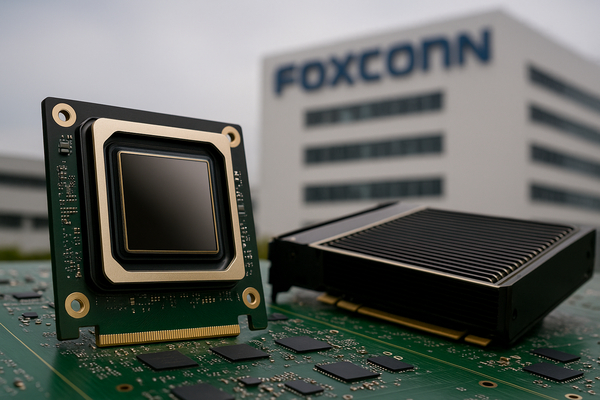
Apple (NASDAQ:AAPL) is facing a product reality check that is weighing on sentiment even as AI hardware orders for Nvidia (NASDAQ:NVDA) and contract manufacturer Hon Hai/Foxconn (TPE:2317) accelerate capex flows. Short term, investors are rotating into chipmakers and data‑center suppliers as CES announcements and production ramps materialize. Longer term, the story matters because rack‑scale platforms and memory tightness can sustain earnings growth and capital intensity through 2026–27. Globally, U.S. and Taiwanese suppliers gain immediate demand; in Europe and emerging markets the impact is slower but real as cloud builds and procurement cycles lengthen. The timing is urgent: production ramps and a recent policy carve‑out for U.S. multinationals are changing near‑term cash flows and tax footprints.
Market Pulse Check
Trading opened with visible flows into AI hardware and infrastructure. Large cap semiconductors led futures gains while some consumer tech names lagged. Exchange‑traded funds and institutional desks are rebalancing exposure toward data‑center supply chains. Retail volumes still favor household names, adding friction to purely fundamentals‑driven moves.
Two contrasting company moves stood out. Nvidia (NASDAQ:NVDA) jumped on news its Rubin platform moved into production and gained supply‑chain support from partners. By contrast, Apple (NASDAQ:AAPL) posted another data point of weak demand for Vision Pro and struggled to find traction for spatial computing. Foxconn’s (TPE:2317) report of strong AI server sales helped lift Taiwan suppliers and highlighted where capex is flowing early in 2026.
Analyst shop activity is also steering flows. Jefferies’ recent sector reposition—upgrading IBM (NYSE:IBM) while downgrading Adobe (NASDAQ:ADBE)—pulled attention to valuation gaps. Meanwhile, corporate actions such as OKTA’s (NASDAQ:OKTA) $1 billion repurchase program signaled confidence and drew buyback‑sensitive funds.
Comparative Deep Dives
Analyst Convictions — upgrades, downgrades and what they imply
Upgrades and downgrades are painting a split market. Jefferies raised its stance on IBM (NYSE:IBM), citing durable enterprise AI demand and margin leverage. At the same time it trimmed Adobe (NASDAQ:ADBE), reflecting skepticism that its AI integrations will monetize quickly enough to change near‑term growth trajectories.
On hardware, banks have nudged price targets higher for leading chipmakers after CES demos and production updates. That optimism centers on Nvidia (NASDAQ:NVDA) and second‑tier benefactors such as TSMC (NYSE:TSM) and memory suppliers. The market is rewarding tangible execution—production dates, shipments, and large OEM deals—over vague product roadmaps.
Risk Events vs. Expansion — regulatory, geopolitical and operational contrasts
Regulatory moves and geopolitical incidents are sitting beside expansion stories. The OECD’s amended global tax plan, which carve‑outs U.S. multinationals from the 15% minimum, changes effective tax exposure for big American firms. That has immediate relevance for multinationals with large offshore profits and can alter after‑tax cash flows used for capex and buybacks.
Geopolitical risk also shifted sentiment: reports of U.S. activity in Venezuela boosted defense‑adjacent and energy stocks, and it fed a short‑term bid into data analytics names such as Palantir (NYSE:PLTR) on speculation of government contracts or operational relevance. Operationally, however, expansion stories remain strong: Micron (NASDAQ:MU) hiked 2026 AI capex to $20 billion to meet HBM demand, and Hon Hai/Foxconn (TPE:2317) is reporting robust AI rack shipments—both concrete growth vectors that contrast with softer consumer hardware demand at Apple (NASDAQ:AAPL).
Leadership and Fundamentals — management moves, insider signals and market reaction
Leadership signals are driving divergent market responses. Some executives are buying stock or increasing insider ownership, which markets often interpret as conviction. Others face scrutiny: analysts flagged Apple (NASDAQ:AAPL) for potential stagnation in 2026 even as management leans into services and wellness (e.g., Fitness+ refresh) to offset hardware softness.
Fundamentally, companies showing clear capacity and order books—chipmakers, memory suppliers, and integrators—are being rewarded. Firms with strong product narratives but few near‑term commercial wins are getting repriced. That disconnect is visible between earnings‑driven upgrades and headline‑driven retail enthusiasm.
Investor Sentiment
Institutional flows are skewed toward infrastructure and capex beneficiaries. Large asset managers and active quant funds are overweighting Nvidia (NASDAQ:NVDA), TSMC (NYSE:TSM), and select equipment names. Retail investors still trade Apple (NASDAQ:AAPL) and high‑profile software names, amplifying short‑term volatility.
ETF flows confirm the divergence: AI and semiconductor ETFs pulled money in, while some consumer tech and spatial‑computing exposures saw outflows. Volume patterns show institutions executing larger block trades into chip supply chains and smaller, retail‑sized trades in consumer hardware.
Valuation disconnects are clear. Palantir (NYSE:PLTR) and other high‑momentum names have seen large price gains that outpace earnings visibility, prompting analyst cautions. Conversely, some solid enterprise franchises with improving margins sit cheap relative to peers, creating tactical rotation opportunities for buyers focused on fundamentals rather than headlines.
Investor Signals Ahead
These contrasts—hardware ramps versus consumer softness, tax carve‑outs versus regulatory uncertainty, analyst upgrades versus downgrades—are likely to reshuffle relative performance in the near term. Stocks tied to production and visible contracts should continue to attract capex‑oriented flows. Names with unresolved monetization on AI features may face tighter sentiment until revenue proof points arrive.
Data gaps remain in quarterly guidance and exact shipment schedules for rack‑scale deployments; those will be key short‑term inputs for portfolios. For now, the market is rewarding execution over promises and capacity over concept. Investors are pricing where revenue and margins will show up first: in chips, memory, and infrastructure services.
Note: This report summarizes recent market moves, analyst actions, and corporate updates. It is informational only and not investment advice.