










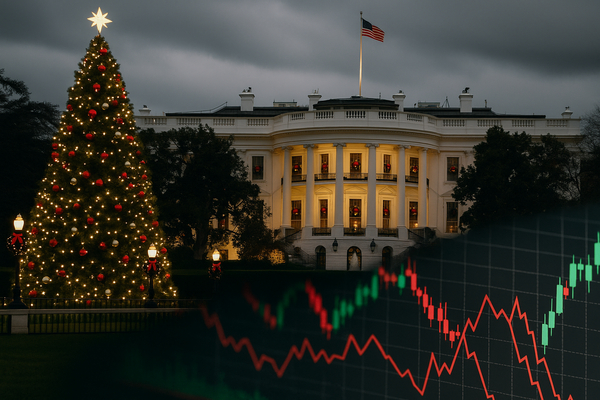
Trump’s White House mixes festive pageantry and policy contradictions. The administration is pairing public cheer with decisions that are reshaping investor sentiment now. Short-term markets are reacting to mixed signals on trade, security and tech hiring. Longer-term flows hinge on policy consistency and global diplomatic ties. The U.S. moves touch Europe, Asia and emerging markets differently. Recent choices echo past episodes of unpredictable governance and are raising questions about fiscal, regulatory and geopolitical risk as the year ends.
Policy contradictions and market mood
Holiday decorations and a Lego portrait on the state floor have not reduced investor focus on policy clarity. The president’s public claims about fitness contrast with moments of fatigue. That matters because markets price confidence as much as policy. When leaders send mixed messages on core topics such as drugs, trade and domestic affordability, risk appetite can wobble.
Investors are watching a string of contradictory moves. On one hand the administration is using military strikes against alleged drug-smuggling vessels and signaling readiness for tougher action in the region. On the other hand a high-profile pardon was granted to a foreign leader convicted in a major narcotics case. Markets respond to such contradictions by raising political risk premiums for certain assets. Consumer concerns about affordability remain elevated, which in turn can weigh on retail sales and services revenue in the near term. Polls that show persistent voter unease over prices reinforce that domestic demand projections could be revised lower if confidence does not improve.
Geopolitics, trade and capital flows
Diplomatic friction is a growing theme. The decision to exclude South Africa from a U.S. invitation to the G20 when it hosts the event has prompted pushback from key European partners. That reaction matters for markets in multiple ways. It can reduce the near-term effectiveness of coordinated policy responses on trade and climate and raise transaction costs for companies that rely on stable multilateral forums.
Emerging markets that depend on predictable engagement with the U.S. may see higher risk premia if diplomatic disputes extend. Germany’s stated intent to change U.S. minds highlights how allies can push back and potentially blunt unilateral moves. Meanwhile, strikes in the Caribbean and talk of operations near Venezuela add geopolitical risk that could affect energy and shipping insurance prices. Asia and Europe watch these developments closely because any escalation can feed through to commodity and logistics costs.
Tech policy, labor rules and corporate planning
Technology policy and immigration rules are converging into a single market story. The administration’s push for more AI data centers is meeting voter backlash at a local level. That friction affects permitting, local taxation and the timeline for large-scale cloud investments. Corporates that planned accelerated capital expenditure for machine learning and data infrastructure may now face slower approvals and higher community resistance, altering deployment schedules.
At the same time enhanced vetting for H-1B applicants changes the calculus for firms that rely on overseas talent. Slower visa processing increases hiring costs and may push some companies to automate or relocate certain functions. In the short term that can boost vendor demand for domestic training and automation tools. In the longer term it could alter where firms base engineering hubs and how they structure global labor footprints. The combination of regulatory friction and local opposition to data centers can compress margins for growth-focused firms that priced rapid expansion into their valuations.
Political calendar and market-moving dates
The near-term calendar contains events that could nudge markets. Follow-up talks between the U.S. and Ukraine on a proposed Russia deal are on the schedule. Outcomes or even the tone of those meetings can affect European security risk assessments and defense-related supply chains. The administration also has public engagements that carry symbolic weight, such as presiding over a high-profile World Cup draw and attending the Kennedy Center Honors. Such events matter because they shape perceptions of stability and leadership focus.
Domestic policy deadlines are also relevant. The mid-December deadline to sign up for Affordable Care Act coverage occurs while Congress debates subsidy extensions. Healthcare enrollment numbers influence federal fiscal exposure and can affect insurers and service providers. In addition, legal cases and election-era finance rulings remain on the watch list for corporate compliance teams and political spending strategists. These items can feed into short-term volatility around sectors sensitive to regulation and public spending.
Market implications and scenarios
Overall, the current political mix is producing a cocktail of short-term uncertainty and longer-term strategic questions for investors. In the short run markets may see greater sectoral rotation as traders react to headlines on geopolitics, tech permitting and immigration. Defensive sectors that benefit from higher perceived geopolitical risk could attract flows. Consumer-focused sectors remain vulnerable to renewed affordability concerns.
Over a longer horizon the consistency of policy will matter more than single headlines. If contradictions persist between enforcement actions and high-profile pardons, trust in regulatory predictability could erode. That raises the cost for cross-border deals and investment projects that require stable rules. Conversely, clearer, sustained policy signals on technology investment and trade engagement would lower uncertainty and help capital planning.
For portfolio teams and corporate planners the immediate task is to map exposures to domestic demand sensitivity, geopolitical risk and tech labor constraints. Monitoring upcoming talks, legal rulings and regulatory announcements will help in assessing whether recent headlines represent transitory noise or the start of persistent policy recalibration. The final weeks of the year will likely set the tone for how markets price political risk into 2026.