










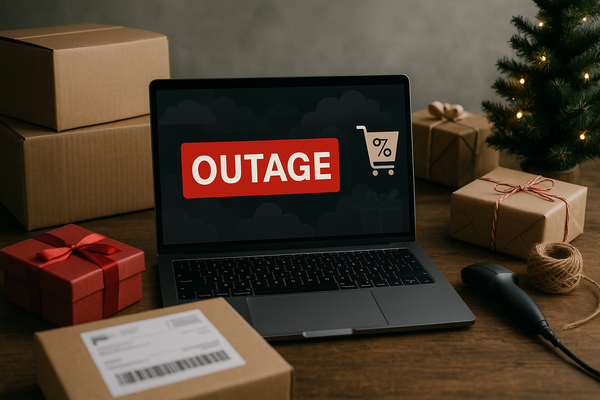
Shopify (“NASDAQ:SHOP”) reported a mixed holiday cadence as strong Black Friday gross merchandise volume and a modest revenue beat contended with a Cyber Monday outage that dented the stock intraday. The timing matters: holiday sales drive short-term revenue and merchant retention, while platform reliability and integrations shape longer-term merchant adoption across the US, Europe and Asia. Short term, outages can weigh on intraday price action and merchant trust. Long term, expanding offline integrations and sustained GMV growth could accelerate Shopify’s platform monetization versus historical e-commerce cycles.
Introduction
This report offers a multi-dimensional view of “NASDAQ:SHOP”. The objective is to reconcile recent technicals, fundamental scores, analyst targets and an intense news cycle around Cyber Monday. We frame what moved the stock, what the data implies now, and how investors might think about the outlook without issuing recommendations.
Key Takeaway: The Trade Engine Score
Shopify’s Trade Engine Score is “74.43”, a moderately high reading that blends technical momentum, fundamentals and market sentiment. A score in the mid-70s generally signals constructive cross-currents: technical trends and analyst optimism favor upside, while operational hiccups or execution risk can trigger short-term pullbacks. Given Shopify’s elevated news sentiment and analyst enthusiasm, the Trade Engine Score positions the stock as one to monitor for conviction on recovery after transitory setbacks.
Recent Price Performance & Earnings Watch
Shopify closed at $149.28. The stock showed no net change month-to-date in the dataset, while year-to-date gains were noted in coverage (roughly +40% YTD in recent reports). The 52-week range is $69.84 to $182.19, placing the share price comfortably off the year high but well above the low.
Technically, Shopify sits above both its 50-day EMA ($141.60) and 50-day SMA ($142.38), and the RSI at 65.86 signals firm momentum without being overbought. The technical score of 60.96 is constructive but not extreme.
Earnings activity is flagged within the seven-day window and the dataset records an earnings report dated 2025-11-04. Revenue came in at $2.844B versus estimates of $2.811B — a modest beat of about 1.2%. Market reaction was nuanced: the revenue beat and a 25% Black Friday GMV uplift were positive drivers, while a Cyber Monday merchant-facing outage produced intraday selling pressure, including a reported 6% drop on the outage day.
Sector Comparison
Against Information Technology sector benchmarks, Shopify’s profile differs in important ways. The sector PE (TTM) sits near 23.16 with quarterly revenue growth about 4.39%. Shopify’s growth metric (score: 87.54) indicates a growth profile well above sector averages, consistent with rapidly expanding GMV and new merchant capabilities. The sector payout ratio of 35.50% is not directly comparable because Shopify historically prioritizes reinvestment over dividends.
Net margin in the dataset reads 0.00% — likely a reporting quirk — but the profitability score (39.22) and fundamental score (75.04) together suggest the company is judged favorably on growth and strategic capital allocation even as margins and near-term profitability remain areas for improvement versus mature software peers.
Fundamental & Technical Analysis
Fundamentals: Shopify posts a strong fundamental score (75.04) supported by high marks on growth (87.54) and capital allocation (49.45%). Profitability at 39.22 and leverage near 49.85% point to a balance between reinvestment and measured financial leverage. Earnings quality is graded B+ with a score of 56.52, indicating adequate but not flawless earnings reliability.
Technicals: The technical score of 60.96, RSI ~66 and price above short-term moving averages together indicate constructive medium-term momentum. Traders will note that the stock is not at 52-week extremes, so moves tend to be driven by news and event risk rather than exhaustion signals.
Analyst Sentiment & News Synthesis
Analysts are broadly favorable: an analyst sentiment score of 85.71 based on 48 analysts and a mean target of $175.13 (median $183.60) imply upside from the $149.28 close. The reported rating counts are tilted toward optimism (1,032 strong buy; 1,703 buy; 1,814 hold; 115 sell; 48 strong sell), reflecting diverse views but a net-positive skew. The target range runs $116.15 to $210.00, highlighting dispersion on timing and execution risk.
News themes on 2025-12-01 were concentrated and consequential. Positive threads: a Black Friday e‑commerce report showing a 25% GMV increase and new offline integrations (Bombas storefront) that validate Shopify’s online-to-offline strategy. Negative threads: a Cyber Monday outage that disrupted merchant checkouts and triggered a sharp intraday pullback. Market reaction combined these inputs — optimism on merchant traction and platform expansion, caution on operational resilience.
Sentiment scores underscore the mix: a very high news sentiment (97.00) shows bullish narrative framing overall, while the immediate trade-engine and technical readings reflect the outage’s short-lived pressure. RBC and other brokers highlighted Shopify as a compelling idea in Canadian tech coverage, reinforcing the institutional positive view even as reliability risk draws scrutiny.
Conclusion
Shopify (“NASDAQ:SHOP”) sits at a crossroads: underlying platform demand and holiday GMV growth are reshaping the revenue runway, while an operational outage during a peak sales day exposed execution risk that can translate into short-term volatility. The Trade Engine Score of “74.43” captures that balance — momentum and analyst conviction versus episodic service risk. Fundamentals skew strong on growth and capital allocation; technicals show constructive momentum. Analyst targets imply room for upside, but news-driven intraday moves remind investors that reliability matters as much as scale for a merchant-facing platform.
For readers: use these data points to inform further due diligence on merchant recovery metrics, post-outage remediation plans, and upcoming earnings details rather than as a basis for an immediate action. The company’s growth trajectory remains intact, but execution on platform stability will determine how cleanly that growth translates into sustainable margins and investor confidence.