









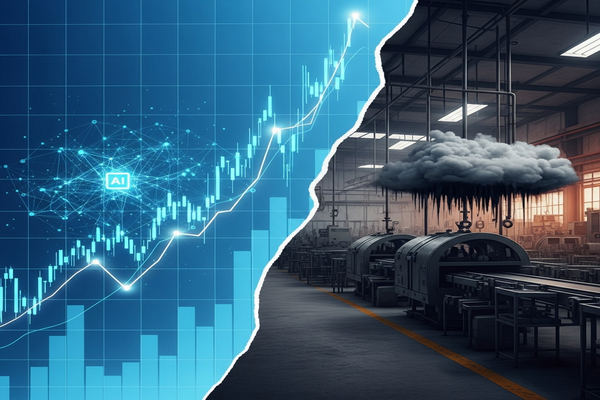
The global economy stands at a crossroads as AI investment drives a fresh growth spurt while tariff policy keeps pressure on manufacturers. New OECD projections warn that markets are pricing in large AI returns that could be corrected quickly. Short term, equities may stay buoyant on AI bets. Longer term, tariff-driven costs and slower underlying demand could restrain growth and lift inflation. The story matters for the US, Europe, and Asia because each region faces distinct trade and investment tradeoffs and because a market correction in AI winners would ripple through emerging markets and credit markets worldwide.
Markets at a glance: AI is driving returns and creating a key downside risk
Equity markets have rallied on the view that AI will generate outsized corporate returns and spur capital investment. The Organisation for Economic Co operation and Development warns that this narrative now sits at the center of its forecasts. The group says lower than expected AI returns could trigger a rapid repricing of risk given high valuations and the presence of leveraged non bank financial intermediaries.
That matters for the coming session because risk sentiment can swing quickly when investors reassess growth assumptions. In the United States, AI related investment helped push headline GDP higher in 2025. Excluding those AI investments the OECD estimates that US activity actually contracted in the first half of the year. In Europe and parts of Asia, AI is also accelerating data center builds and corporate capex. However, that concentrated optimism raises vulnerability to a correction in tech and growth sectors.
For global markets today expect continued rotation between name specific tech winners and cyclicals. Stocks tied to AI adoption and semiconductor capital expenditure will draw attention. Credit spreads and leverage metrics in non bank finance should also be watched as a barometer of systemic risk appetite.
Manufacturing under pressure as tariffs keep firms reshaping supply chains
Manufacturers continue to feel the direct cost of trade policy. The Institute for Supply Management reported a November manufacturing PMI reading of 48.2. That marks nine months below the 50 threshold that separates expansion from contraction. New orders fell sharply and the employment sub index dropped to 44, signaling slackening labor demand in the sector.
Executives surveyed describe more permanent changes to operations. Some transportation equipment producers are cutting staff and moving production offshore. Chemical and electronics firms cite higher landing costs and persistent trade confusion. Freight and port operators face shifting regulations that complicate route planning and pricing. At the Port of Long Beach and other major hubs, companies are recalibrating sourcing and logistics to manage tariff risk and rising costs.
For markets this dynamic supports selective pressure on industrials, machinery, and capital goods stocks. It also boosts the relevance of suppliers tied to new technology trends that can offset lost demand. One example is rare earth producers that feed data centers, electric vehicles, and defense supply chains. Lynas Rare Earths ASX:LYC is a name investors will note as demand for specialized materials rises as firms invest in digital infrastructure and manufacturing tools.
Macro outlook: growth, inflation and policy signals to watch
The OECD set out a moderate growth path with meaningful caveats. Global GDP is projected to slow from 3.2 percent in 2025 to 2.9 percent in 2026 and then edge up to 3.1 percent in 2027. The United States is forecast to ease from roughly 2 percent growth in 2025 to 1.7 percent in 2026 before a modest rebound to 1.9 percent in 2027. Crucially, the OECD flags tariff related price effects that could lift inflation to about 3 percent in 2026 before returning to near 2 percent by the end of 2027.
Those numbers shape expectations for central banks and bond markets. The OECD notes that the full impact of tariff increases on US activity may not yet be felt and that a hiring cooldown and lower immigration will also weigh on demand. The group suggests the case for further interest rate cuts next year, a signal that financial markets will parse for timing and magnitude. Bond investors will react to any change in the perceived durability of inflation driven by tariffs and energy prices.
In the near term traders should watch US inflation measures, payrolls, and any comments from Federal Reserve officials that clarify tolerance for tariff induced price pressure. In Europe and Asia, data on industrial output and capital spending will help determine whether the AI driven capex story can offset slower underlying demand.
Trading session roadmap: what could move markets today
Expect the market narrative to hinge on three cross currents. First, fresh risk appetite for AI beneficiaries will keep tech leadership relevant. Stocks tied to cloud infrastructure, chips, and enterprise software could outperform if earnings commentary supports continued investment. Second, manufacturing weakness and tariff related cost passthroughs will keep pressure on industrial and materials names. Watch companies in transport, chemicals, and electronics for guidance on sourcing and pricing. Third, bond markets will react to any indication that tariff inflation is persisting or that central banks will adjust the timing of rate cuts.
Key data and indicators for the session include short term moves in equity indices, US and German sovereign yields, and the US dollar. Commodity moves in base metals and energy will show whether industrial demand expectations hold up. Watch credit spreads, especially in leveraged non bank finance groups, for signs of stress should equity turns provoke forced sales.
Market participants should also track corporate commentary. Quarterly reports and management guidance that discuss AI spending, supply chain reconfiguration, and tariff exposure will be read through the broader macro lens the OECD and manufacturers have highlighted. Any surprise on the downside in new orders or employment readings will amplify sector rotation toward defensive and value oriented names.
The balance for today’s session is delicate. AI driven investment is reshaping growth expectations and keeping markets elevated. At the same time tariff policy and persistent trade uncertainty are reshaping corporate behavior and pricing. Traders and investors will weigh both forces as they set positions for the day and the coming weeks.